
Conan Makes a Good Point- Streaming Ad Interruptions are a Problem
The medium isn't meeting the moment


Conan O’Brien took a maybe-cheap/maybe-right-on-the-nose shot at YouTube the other night during the Oscars. With the help of Jane Lynch, he imagined what the Academy Awards broadcast will look like on YouTube in a few years, complete with jarring, low-rent ads.
Honestly, I’m betting that YouTube will do a great job with the awards - and will probably be a bit conservative in their ads presentation - at least for the main broadcast - as the platform did for its first NFL game last fall. The ad experience on the Oscar shouldn’t be an issue, because like sports, the Oscars have naturally built-in ad breaks.
However, that doesn’t mean that YouTube couldn’t be better with the when and how it delivers mid-roll ads. But it’s really an industry problem.
Check out this research from Ring Digital:
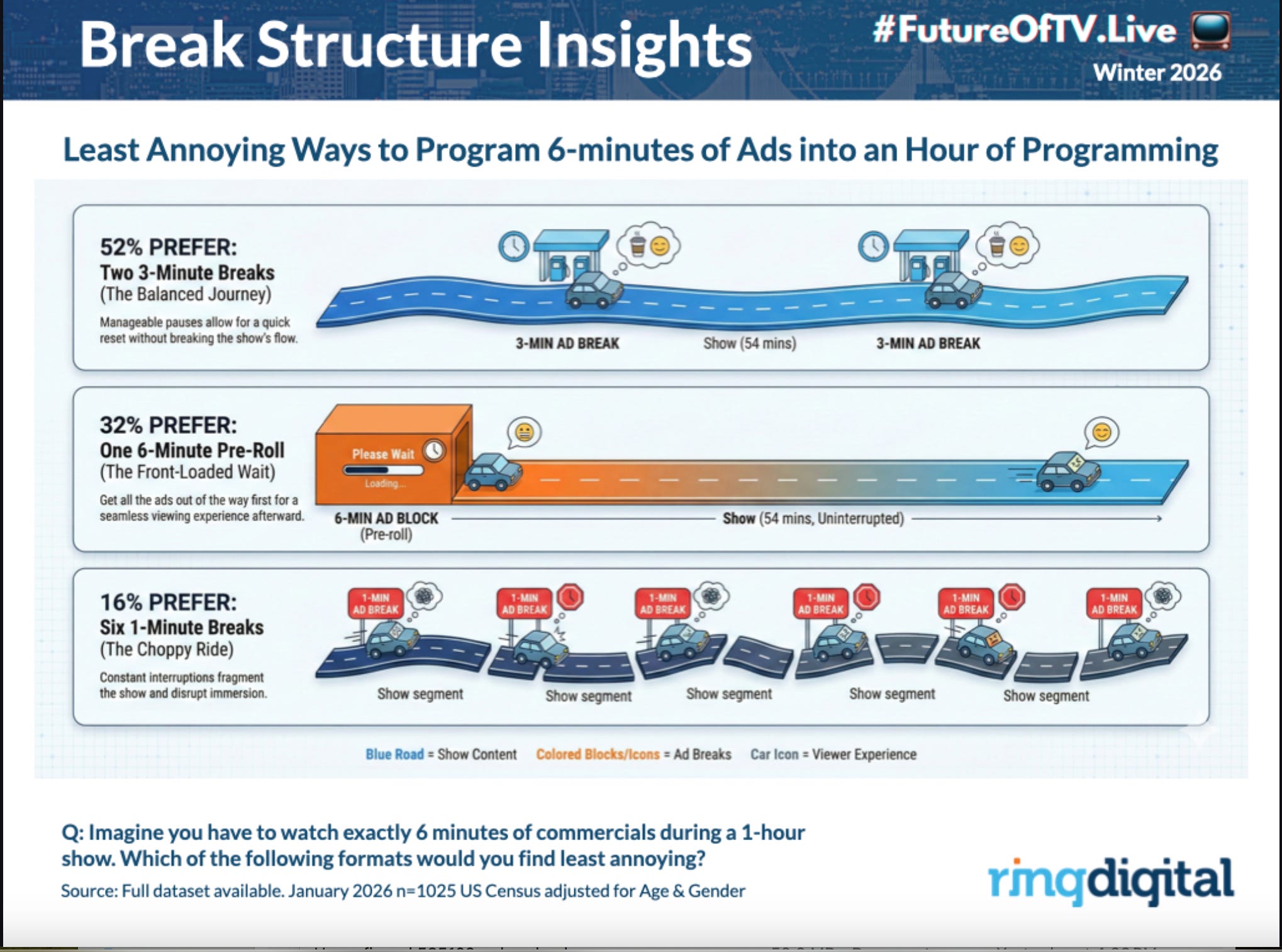
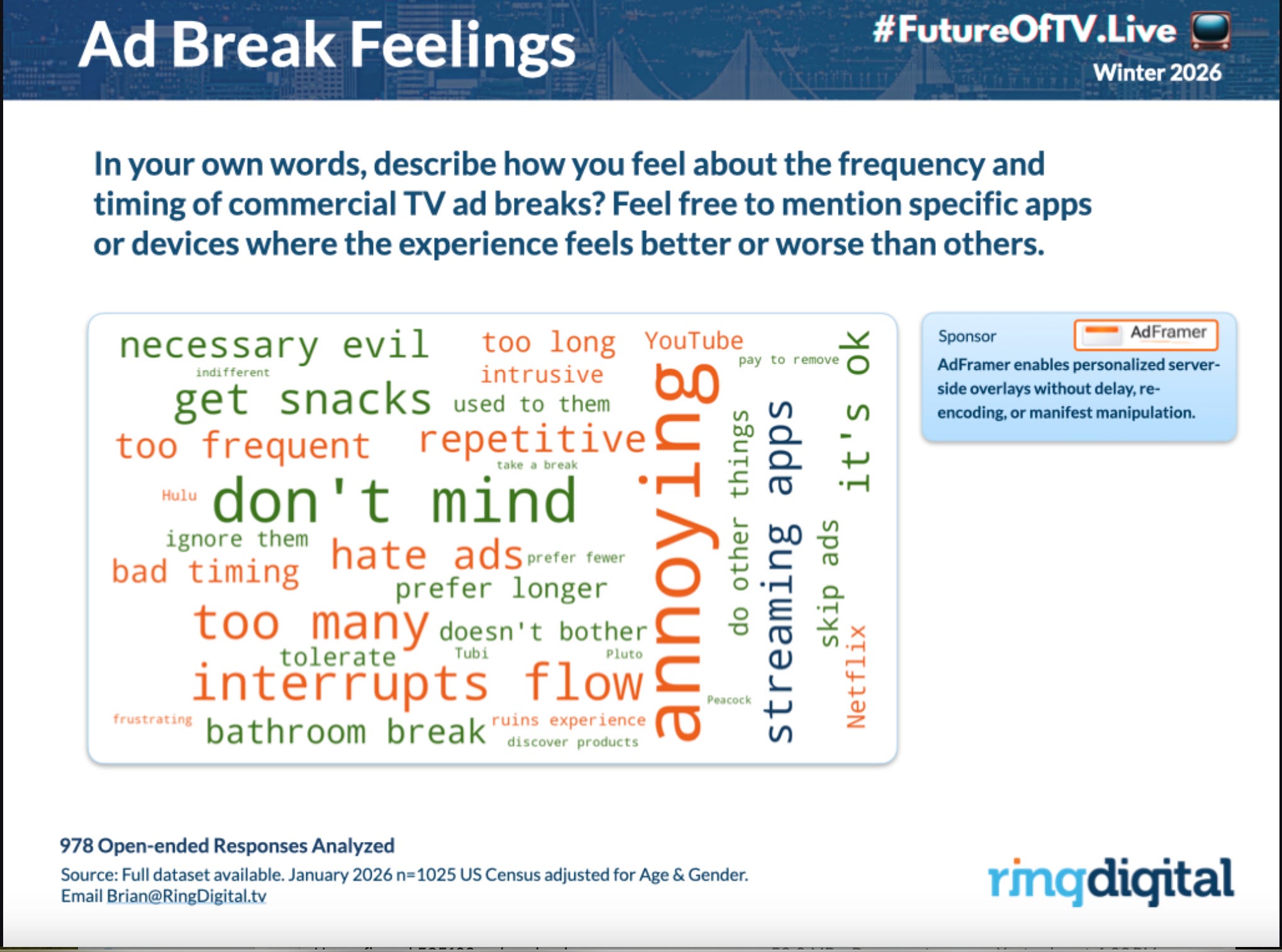
People are ok with streaming ads, and actually prefer more traditional breaks than otherwise - but they also feel that streaming ads are annoying and ruin the content flow.
Unfortunately, the more that streaming platforms rely on automation, the more that ads get ‘shoved’ into content whenever the ad tech being employed deems it is time. I’ve seen these abrupt mood-wrecking ads get inserted at just the wrong time on Amazon Prime (even on former network TV shows with natural ad breaks) and Hulu - where I was watching a very intense World War II movie only to be ripped from a battle scene for a message from Burger King.

To be fair, things weren’t much better in the days of watching “Roadhouse” in three hour increments on TNT on repeat - but at least someone was taking the time to find the ends of scenes to go to a commercial break.
Still, shouldn’t streaming, with all its tech, metadata, contextual targeting and now AI, be a lot better? Yet, “in many cases, advertisers don’t have consistent visibility into the underlying content across even the most premium streaming supply out there,” said Ria Madrid, VP of Advertising at Wurl. “Whether that is by design, due to lack of standardization, or just a product of fragmented infrastructure that leads to inconsistent and unreliable metadata.”
So which is it? Well, some theories:
Things just go too complicated, and too crowded, too fast
“Arbitrary streaming ad placements are a by-product of TV advertising becoming both more accessible and more complicated,” said Jake Richardson, VP, Partnerships at Gracenote. “Formerly, ad insertion was done at the network level on linear, [versus today where we’re] moving to a scalable ecosystem with much of this being outsourced. Beyond this, every streaming publisher has different ad loads…which vary in terms of placement and minutes per hour so we end up with some of these unnatural breaks in content.”
The tech wasn’t necessarily built for this
It turns out, you can’t blame this interruption mess on ad serving companies or even SSPs, since they don’t decide where the ads actually appear during shows - just the timing of those ads, which ads show up, say ad tech experts. “We don’t own SSAI tech,” explained Catherine Dale, Vice President, Revenue, SpringServe, referring to Server-Side Ad Insertion - the domain of companies such as Amagi and Conviva. “We do work closely with those partners on monetization and our tech is able to optimize pods for premium user experience, compiling them without duplication, honoring competitive separation and any other rules as dictated by the media owner.”
It’s the streaming platforms’ fault (or the tech isn’t being used properly)
In other words, some of the media owners either aren’t trying (and just letting ads show up whenever) or not employing SSAI to its potential. “The major app aggregators set the overall constraints for ad break patterns that publishers need to cleanly fit into; and some publishers have more sophisticated content operations and playout systems for this task than others,” said Brian Ring, a former Amagi who now runs his own research consultancy.
Live is hard. Creators are even harder.
It’s one thing to dynamically inserts ads into slots that were designed to house 30s on linear TV. It’s a whole other matter to pop ads into the right moments during a live broadcast, or particularly in creator videos that don’t have typical acts or breaks. Even YouTube seems to struggle here identifying moments that feel mid-roll-worthy - at least without human oversight. “For live content, such as sports, it’s often essential for a live operator to press a red button indicating a break should be inserted at that moment,” said Ring. “That is manual and expensive for long- and mid-tail properties.”
Contextual ad targeting could help
So what to do? Here’s one theory. Use the tech being developed to find genres and scenes that work for ads, and enable it to find breaks in narrative or scenes. “This is where scene-level targeting is starting to make a real difference,” said Madrid. “By interpreting content the way a viewer does – through a combination of sight, sound, and emotion – scene-level targeting allows advertisers to align their messaging with the moment. The result is a more precise and intentional connection between brands and consumers, where ads show up alongside content that matches the viewer’s mindset and level of attentiveness.”
“By jamming CTV impressions into the performance bucket, we’ve watered down the user experience,” added Richardson. “The big misjudgment we see is people in our industry believing that the tech giants drive advertiser outcomes based solely on user data. In fact, knowing what the viewer is watching is equally important as who the viewer is.”
Of course, this assumes that enough brands will find value in CTV contextual targeting that as a side benefit - the viewer-interruption-experience becomes better. Here’s hoping.
Go Addressable Young Man
Starting on March 31, I’m kicking off a multi-part podcast series with my partners at Go Addressable, a cross-industry trade group aimed at elevating the practice of intelligent, data-driven targeting in TV advertising. We’re going to be talking to leaders from across the ecosystem about the potential for more addressable TV campaigns, what’s working, what isn’t, what’s in folks’ way - and what TV targeting nirvana might look like. So stay tuned!