
Breaking Down Retail Media's Vibe Shift
Can anybody compete with the Big Two?

According to Vibe, small brands can get on TV for just 50 bucks.
For Walmart, that was apparently worth $1.4 billion.
The eye-opening acquisition was the talk of Cannes last week (besides, don’t mind my sweat). It’s clearly a huge deal for Walmart - and perhaps one carrying much bigger ramifications for the Retail Media industry at large, as well as the fledgling CTV sector for small to mid-sized advertisers.
Retailers are running out of room. Do they all need a TV story?
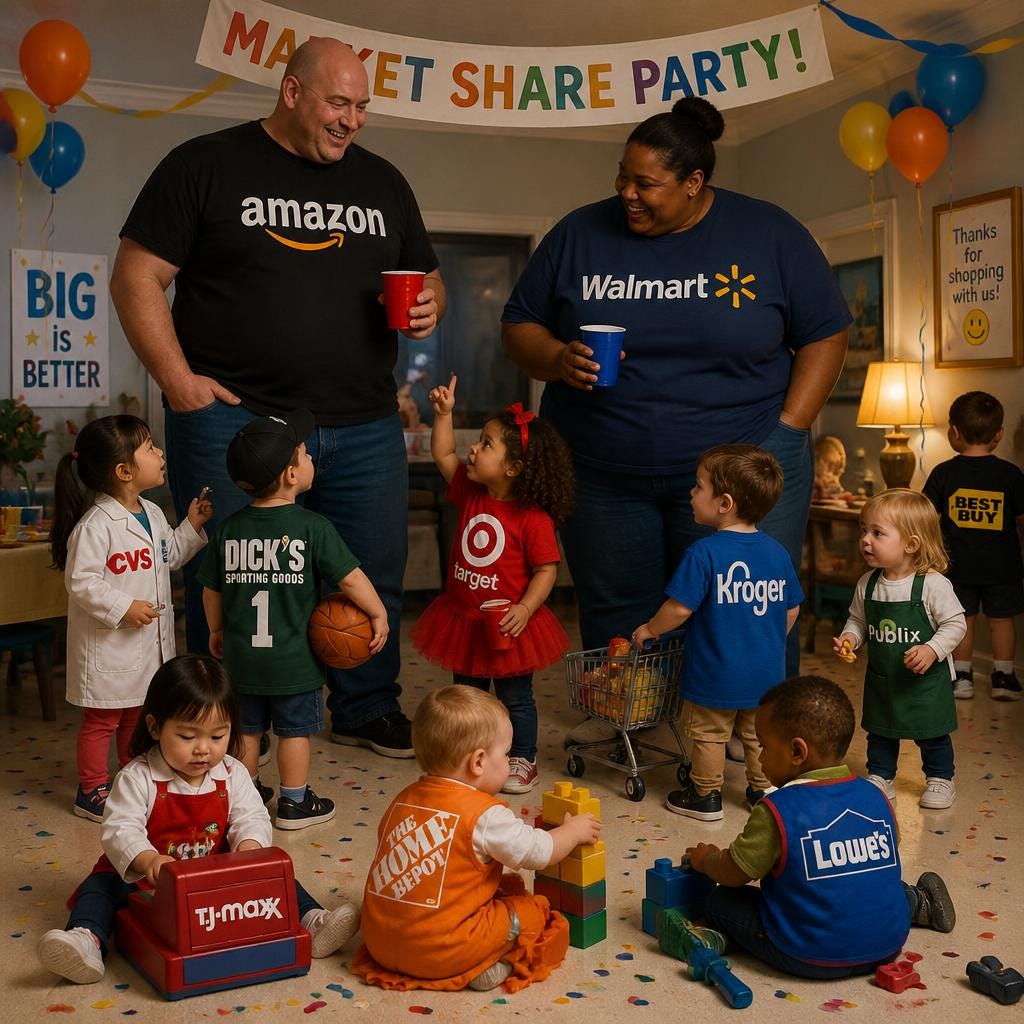
An agency executive I spoke to in Cannes talked about how all the major retail media networks - after exploding onto the scene in recent years - are all looking for their next growth story. It’s not a stagnant category per se, but everyone seems to be waiting for ‘off platform’ to boom. In a category of 200 to 300 players at least, Amazon and Walmart now command an insane 85% market share.
“As retail media becomes more integrated with the broader media plan, brands will not be able to manage 200-plus fragmented retail networks, each with its own audience definitions, buying tools, measurement methodology, and attribution logic,” said Paul Frampton-Calero, CEO of Goodway Group
You have to wonder if TV, and the ability to promise (and control) full-funnel ad offering, is going to prove to be the differentiator/separator in this space, as Retail Media morphs into Retail Media Data Goes Everywhere - Particularly CTV Media.
“They are all starting to cap out,” said Tommy Burton, vp of Global Partnerships at Pacvue. “That’s why you see many retailers pushing in-store ads. When it comes to digital, the place they are trying to move money ‘off-site’ is CTV, and that’s where Walmart is headed here.”

As part of my Next in TV series with my partners at Vizio, I shot an episode of Next in Media on the ground in Cannes with Michael O’Donnell, Vizio’s Chief Revenue and Strategic Growth Officer. He talked about the connectivity that Vizio provides to ROI-focused brands.
“Scale is critically important,” he said, noting that Vizio expects to sell 25 to 30 percent of all TVs in the US. “Distribution matters.”
“Outcomes are kind of the scoreboard. And what we want to do is we want to be able to deliver an experience for our customers that starts up at the top of the funnel.”
“How do we help our advertising partners understand that journey? The smart way to do it, we think, is to be able to understand all the signals that are delivered to us along the way.”
Why this deal might pay off quickly - Walmart Marketplace
Perhaps an under-appreciated aspect of the Vibe acquisition - Walmart now has over 200,000 resellers using Walmart Marketplace. These are prime candidates to turn into small TV advertisers (not to mention the fact that Walmart also owns Sam’s Club, and its reseller market).
“The deal hasn’t closed yet, so I can’t share too much,” said O’Donnell. “What I can say is I think what’s important for us is that we continue to bring more and more new advertisers into the fold. And, you know, Walmart Connect has a robust marketplace business - [one with potentially] a lot of new advertisers.”
“How do we make it simpler and easier for them to bring them into the connected TV space? That’s a huge opportunity to expand the TV marketplace.”
What does this mean for Walmart Connect and The Trade Desk?
Walmart Connect was built on TTD’s tech. Yet in recent years, Walmart has pulled away from its exclusivity with TTD. Vibe is a DSP - so who needs TTD, right?
Well, Vibe is built specifically for CTV, and helping small brands plug into self-serve TV ad platforms.
Meanwhile, Walmart Connect is designed to help brands buy all sorts of ads - display, text, video, etc. - on Walmart.com, its mobile app, and all over the Web. This is not Vibe’s department, at least for now.
“Vibe and the Trade Desk are really different customer bases right now,” said Burton. “The Trade Desk is more threatened by Walmart’s recent openness, working with Magnite, and Yahoo’s DSP, etc.”
Can Walmart turn Vibe into it’s version of Amazon’s DSP?
Here’s where things get interesting - and where the pressure really mounts for other retailers. Look at what Amazon has done in the past year. It has taken its killer consumer ID data and conversion data, plugged it into its fast-emerging DSP, and struck deals with the likes of Netflix, Spotify, Disney and others. Can Walmart do the same for Vibe, at least in TV? That would make thing harder for any retail player that doesn’t have all these ‘stack’ pieces. But, such moves would be limited to CTV - most likely.
Or maybe not. “I do not see it as just a CTV deal — I see it as Walmart building connected commerce infrastructure,” said Frampton-Calero
If TV is going to do indeed become democratized, is it going to be driven by the platform giants? What does that mean for other startups?
Consider that:
Walmart will soon own Vibe
Pinterest is buying TVScientific
Magnite purchased Streamer.ai
Amazon already has a massive long tail of SMBs to sell TV ads to
Google can do the same with YouTube
Comcast has Universal Ads
It seems like the winners in this would-be sector are going to be be - duh - giants that already have huge ad demand, rather than a startup just doing that all on its own.
“It’s hard to see others being able to follow in Amazon’s or Walmart’s footsteps,” said former president at Mediaocean Ramsey McGrory. “Google, Amazon, Meta, and soon to be TikTok have millions and millions of SMB accounts that provide a revenue and pricing baseline. After Walmart, who is even close to having the capital to do anything? Target?”
And while MNTN seems to have a solid business (albeit from a less long part of the long tail), do they suddenly become an acquisition candidate? What about someone like Moloco? Do the Paramounts and Disneys of the world need to give up on their individual self-serve platforms and come together - or become buyers? Maybe they become a lifeline for the rest of the RMN world. Or maybe, as Marketecture smartly suggested, they go after Tatari - which already has relationships with many big TV media companies.
It may be time for alliances
Burton noted that after Amazon and Walmart, other RMNs are way down in the pecking order. “No planner is thinking about CVS after maxing those guys out,” he said.
Therefore, it might be time to build some kind of data cooperative, or complementary selling mechanism. Burton suggested the likes of Home Depot, Best Buy and CVS working together in some fashion, for example.
“I think there is room for 10-to-25 scaled retail media or commerce media ecosystems over time, plus a set of alliances that connect customer data across non-competitive verticals,” said Frampton-Calero, who used categories such as grocery, pharmacy, health and beauty, as potential examples.
Or - would any other major retailer become a tech buyer?
Would Roundel ever be able to afford a Tatari? Who else is that serious about scaling its RM business?
Last question - if Walmart Wants to Compete with Amazon - does it Need Original Content?
I’m not suggesting that Walmart is about to run out and buy up some NFL rights. But I could see some experimental attempts at original content for its Walmart+ product. Given how much the company is enamored with advertising (and its profitiability), all bets are off. That is, until they find out just how expensive TV production is.
“I would also expect Walmart to keep investing in content and creator-led experiences over time,” said Frampton-Calero. “If commerce media is going to compete for brand budgets, it cannot just measure existing demand — it has to create demand too.”