

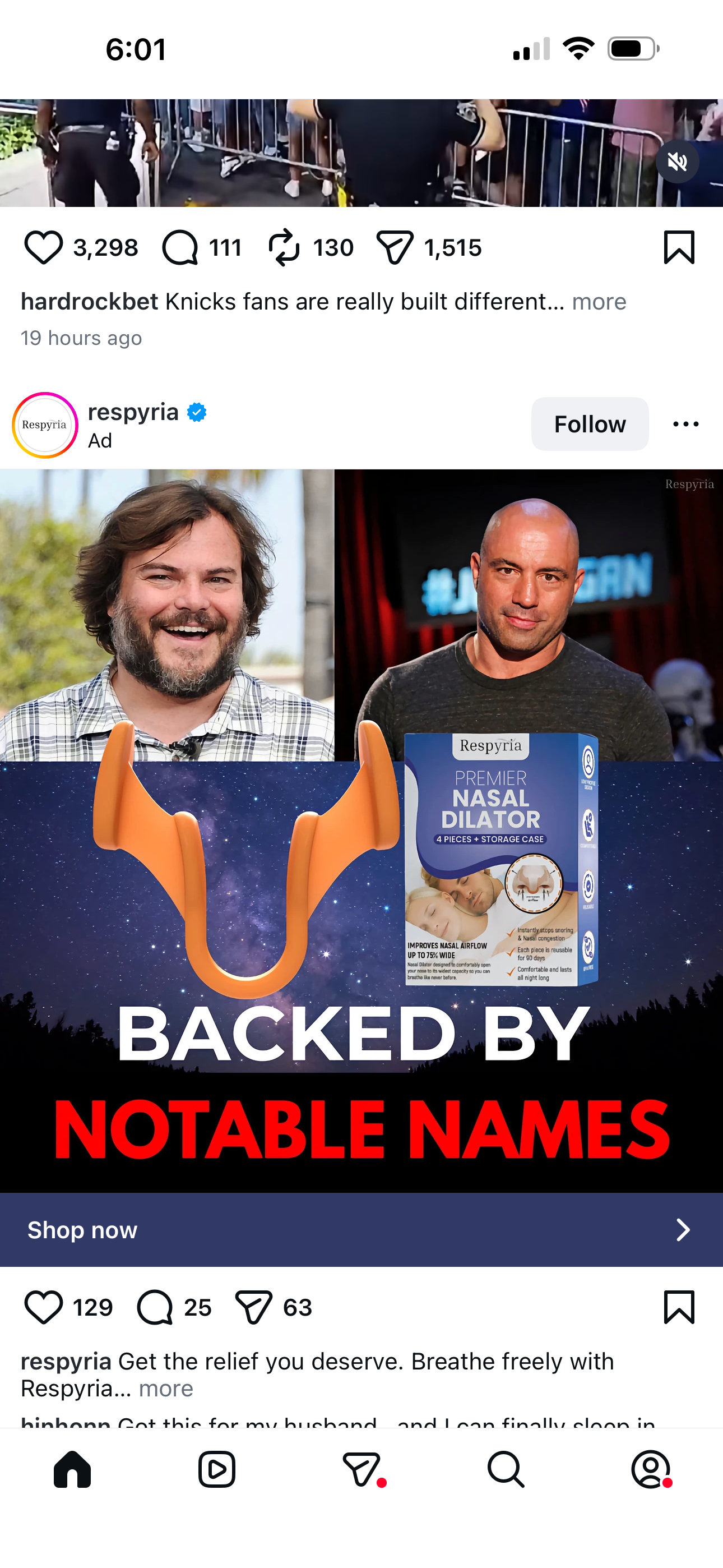
For reasons I can’t explain - because I sleep beautifully and make no breathing noises at night that would alarm or disturb a spouse in any way, I have been getting a bunch of ads for snoring prevention devices on Instagram.
The other day, I got one from the nasal insert device Respyria featuring a clip from Jack Black singing the device’s praises on Amy Poehler’s “Good Hang” podcast.
As a curious media observer, I first thought, “a well-known and beloved celebrity like Jack Black organically brings up a company’s product in a very positive way, and they turned it into an ad. Wow, that’s smart. Plus, if it’s good enough for Jack Black, maybe I should pick up this device in case I ever need it.”
Only I looked it up on YouTube, and found the same clip I saw from Black on Poehler’s show - and he wasn’t talking about Respyria - he was espousing the use of CPAP machines for snoring.
Hmm, that’s really weird, I thought.
Then, I saw another ad for Respyria featuring a similar clip from Joe Rogan’s podcast during which he was talking about using the device for sleep apnea. Again I turned to YouTube, and the conversation didn’t mention Respyria at all.
I couldn’t find any mention of Rogan endorsing this product. Maybe there are clips out there, but I couldn’t find any. This guy says they are deep fakes.
I wish I could find the clips I saw of Black and Rogan espousing Respyria - but alas, they were fleeting. I did take a few screenshots of these static Instagram images which tout celebrities allegedly endorsing the brand.

I reached out Respyria, Instagram, The Ringer (which produces “Good Hang”) as well as whatever contact info I could find for reps for Black, Poehler and Rogan - thus far, nobody’s gotten back to me.
I know deep fakes have been a thing for a while - and that even various attorney’s general are on this issue. It’s even happened to Taylor Swift.
But I was struck by just how convincing these ads are - and how insidious the tactic is to pull footage from ‘real conversations,’ not ads. I wonder how big a problem this is set to become in a world where creators are increasingly becoming the central way consumers discover brands.
It sure seems like Instagram - part of a self-described super intelligence company - has a serious problem brewing.

Playing Near the Third Rail
At a time when many brands are averse to even running messages alongside straight news, let alone anything controversial, the YouTube-centric creator company Jubilee Media is leaning right into third rail issues - ranging from deportation battles to liberals debating MAGA devotees to women confronting mens’ right’s advocates.
I had Jason Y. Lee on the Next in Media podcast this week to talk about the company’s success, its approach to more traditional programming formats, and how it makes advertisers comfortable with all these supposed hot button issues.
“I think what sets Jubilee apart is that we are creating space for real human conversation and real humans that show up. Of course, very naturally, people are going to disagree with certain guests, certain perspectives. But I think in a lot of ways, our goal is not to validate or say, ‘hey, you need to think this way or that way.’ We are really someone who wants to reflect the way people are thinking and interacting. And that’s what makes us really, really popular.”
A lot of the partners and the brands that want to work with us recognize that that’s what young people are looking for too. And they want to appear with us because it feels more honest, more unscripted, more fresh than traditional media.”
On creator companies as media sellers:
“When YouTube started having upfronts, for example. I think that that was like a really big sign of things to come. It’s making brands take digital spend much more seriously. And frankly, allocate way more time, money and effort into what is getting way more traction than these kind of like traditional linear spends. [Yet] we still have yet to see really the the appropriate proportion of spend.”
On Gen Z’s attention span:
“A common episode of “Surrounded” will be over an hour and a half. And people will say, on YouTube, young people can’t pay attention. But we find that our average view duration for those videos are over 40, 45 minutes. So we know that people are watching this. “
Check out the full episode here: